


One of the oldest ideas surrounding fire in Ukrainian folklore is its divine and purifying power. Traditional beliefs hold that fire can belong to three realms – earthly, heavenly, or subterranean. The first two kinds are generally benevolent: they bring warmth, prosperity, and fertility, and play a central role in agrarian rites. But the underworld fire is feared as a destructive force that threatens both people and crops. This tripartite vision underscores how closely rural Ukrainians linked fire’s qualities to the cycles of nature and community well-being.
Fire’s Dual Nature in Early Cultures
In early animistic thought there was no sharp line between living and non-living: every element of the environment was possessed of spirit. Fire’s own “behavior” – its birth in a spark, its roaring height, its eventual dying ember – mirrored the stages of human life from infancy through maturity to decline and death. Observers watched flames devour wood, straw, or grain, and likened this consumption to a mysterious creature eternally hungry. A classic Ukrainian riddle captures this image: “No matter how much it eats, it is never full.” At the same time, hearth-fires offered gentle, nurturing warmth, while wild blazes could obliterate whole forests or fields, reinforcing the notion that fire’s character could shift from protective guardian to hungry destroyer.

Such capriciousness led people to personify fire as a spirit or minor deity, worthy of propitiation. Around the world, countless cultures made small offerings to the living flame. Native American tribes in North America dropped a pinch of tobacco into their sacred hearth while chanting, “Take this, burn, but do no harm.” Mexican Indians and the Mongols, Evenks, and Turkmens of Central Asia all maintained similar customs, casting morsels of food or a little drink into the fire just before sitting down to eat—an act meant to keep the fire-spirit benevolent and guard against its wrath.
In more elaborate pantheons, these fire-spirits became full-fledged gods. In India, Agni – whose very name means “fire” – serves both as the divine personification of the earthly flame and as a link between mortals and celestial realms. In the Hebrew tradition, the ineffable God-Spirit often manifests through burning bushes and pillar-like flames. Zoroastrians worship Ahura Mazda in a cult centered on ever-burning fires, believing that direct prayer to the flame brings instantaneous divine attention without any intermediary object.
Ritual Practices: Protection, Trial, and Punishment
Within Ukrainian ritual practice, fire remains a potent force of protection and blessing, frequently paired with water as the two primal elements of creation. On Ivan Kupala night, young women float wreaths – sometimes carrying small candles – on river surfaces, interpreting their patterns of drift or sinkage as omens of future love and fortune. In medieval Europe a parallel custom saw pilgrims walking barefoot over glowing embers as a sacrifice to a chthonic fire-deity. Over time, such austere rites gave way to the far more jubilant bonfire dances and leap-through-the-flames ceremonies that survive in villages to this day, celebrating fire’s enduring dual capacity to both challenge and safeguard human life.
On the Feast of Epiphany, the power of fire is woven directly into Christian rites. In many villages a blessed beeswax candle is plunged three times into the icy waters or a frozen pond, the flame symbolically “cleansing” and hallowing the baptismal font. Shortly afterward, incense – another form of living fire – smolders in the church censer. With red-hot coals in its bowl, the thurible is swung so that fragrant smoke drifts over both people and sacred objects, linking the ancient cult of fire with the new Christian sacrament of purification.
Yet fire’s darker associations were never far from people’s minds. Folk tales tell of witches who can ignite a home by slipping an ember – soaked in a secret brew – beneath the threshold. As soon as the hidden coal glows, the walls and rafters blaze, leaving the household defenseless. Conversely, the same element serves healing purposes: when an old wise-woman wishes to divine an illness, she fills a basin with clear water, carries it to the stove, and drops in a live coal. The way the ember dances, crackles, or sinks reveals the nature of the patient’s ailment and guides her remedies.
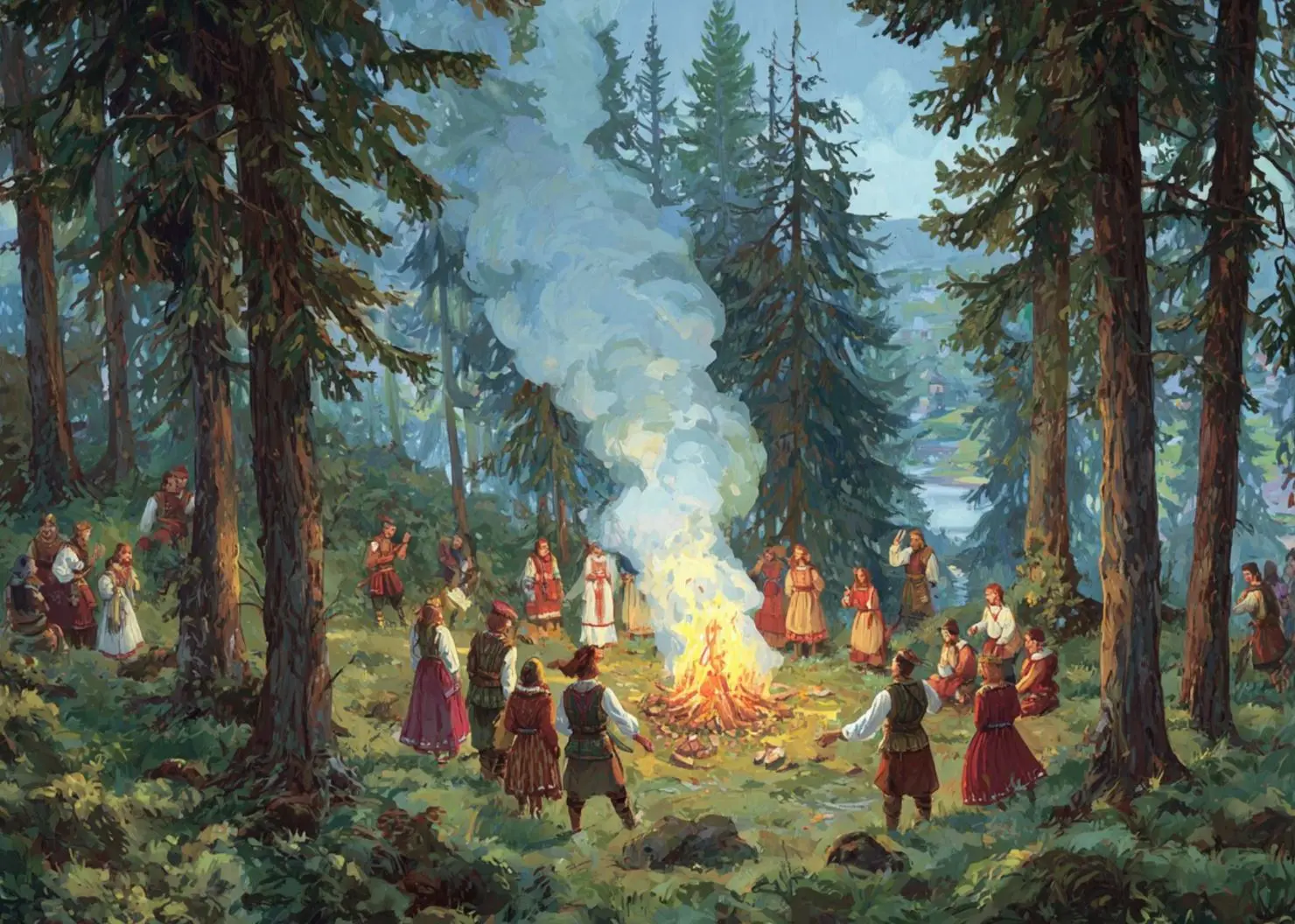
With winter’s end came the joyous rite of leaping over spring bonfires. Young men and women, hand in hand, vaulted the roaring flames to shed both the cold and any lingering misfortune. The Bible itself alludes to such rites: “There shall not be found among you…anyone who makes his son or his daughter pass through the fire,” warns Deuteronomy, branding the practice an abomination before the Lord. Nonetheless, even this solemn text betrays a distant memory of fire’s purgative role in pagan custom – one that Christian poets and preachers would continue to condemn even as the people embraced it.

Marriage ceremonies, too, enlisted fire’s dual nature. Before a wedding, bride and groom were led through a narrow corridor of blazing torches or leaping embers – a test of their courage and a ritual cleansing of old ties. Matchmakers would hold two taper candles to one flame until their wax melded, signifying the union of two family hearths into one. In some regions, after the wedding night, village women accompanied the new bride outside the town’s edge to build a small bonfire, from which the pair would again leap – this time celebrating fertility and the warmth of their shared future.
Fire’s holiness was so deeply felt that even justice was entrusted to it. In pre-Christian times, a suspect accused of foul deeds might be cast into a ring of flames; the innocent would emerge unscathed, the guilty burned by their own guilt. From this belief sprang the proverb “on the thief, the hat – on fire,” a reminder that crime betrays itself. In later centuries, the medieval Inquisition appropriated a grimly similar ordeal by fire to “prove” heresy, echoing the ancient conviction that the element itself cannot be fooled.
The Underworld Flame
Underneath the world of rye fields and forest glades, Ukrainian folklore places a mighty, ever-burning flame that belongs to the “lower” realm of ancestors and monstrous spirits. This subterranean fire was no mere backdrop – it was a living presence. Priests and villagers alike kindled ritual bonfires at the summer and winter solstices, beseeching underworld deities for good harvests or relief in times of plague and famine. At moments of great calamity, they would again light sacred flames, hoping the roaring heat would appease wrathful gods and lift the shadow of misfortune.
Fire’s red and golden hues, however, were not always benign. In many folk tales, these brilliant shades were markers of demonic trickery. A stray coral bead or a bright silk ribbon might conceal the presence of a fire-breathing serpent. Legend tells of market vendors – actually devils in disguise – selling red scarves so potent that once worn, a woman could neither enter church nor speak a prayer; she would collapse at the threshold, foam at the mouth, until priests sprinkled holy water to wrest her from evil’s grip. Some, sadly, never regained consciousness.

The Devil himself often appears in folk ballads as a handsome youth sporting a crimson cap or a brilliant red plume. He may promise boundless riches, only to curse his victim with “burning money,” wealth too hot to hold. Thus arose the proverb “to rake the coals with another’s hands,” a warning against schemes that harm others for personal gain.
Ukrainian myths cast the elemental flame in the shape of a colossal underworld dragon, guardian of molten treasure. Remnants of a similar image appear in the Norse Poetic Edda, where the dragon’s hoard is called “flame-red wealth.” Ukrainians imagined that at night, faint blue sparks – like will-o’-the-wisps – marked the buried trove. To unearth it without curse, one might fling a cap or boot into these flickers or wait for the legendary flaming fern flower that blooms only on the eve of Ivan Kupala. In fairy tales such as “The Edge of the World and the Three Kingdoms of Copper, Silver, and Gold,” a young hero passes through each metal realm – where people, sheep, even herbs gleam like burnished bronze or burnished gold – until finally he confronts the fiery serpent at the heart of the golden kingdom itself.

In Ukrainian folk belief, only the blacksmith – with his mastery of flame and iron – can truly tame the subterranean fire. Forged in the bowels of the earth, this “underworld flame” links him to hidden powers and, in some tales, even to devilish patrons. It is no accident that blacksmiths appear most often as dragon-slayers in local legends, wielding their hammers and tongs against serpentine demons born of volcanic fire.
The Hearth as Threshold of Worlds
Equally revered was the hearth fire of the family home, thought to be an earthly reflection of the celestial flame. Villagers insisted that a dwelling’s layout mirror the universe’s design; only then could it serve as both sanctuary and microcosm of cosmic harmony. The stove – alongside the central beam, the chapel corner, and the threshold – became a sacred locus. Here, through offerings of bread, milk, and prayer, a household maintained its dialogue with gods and ancestors, inviting blessings and warding off misfortune.
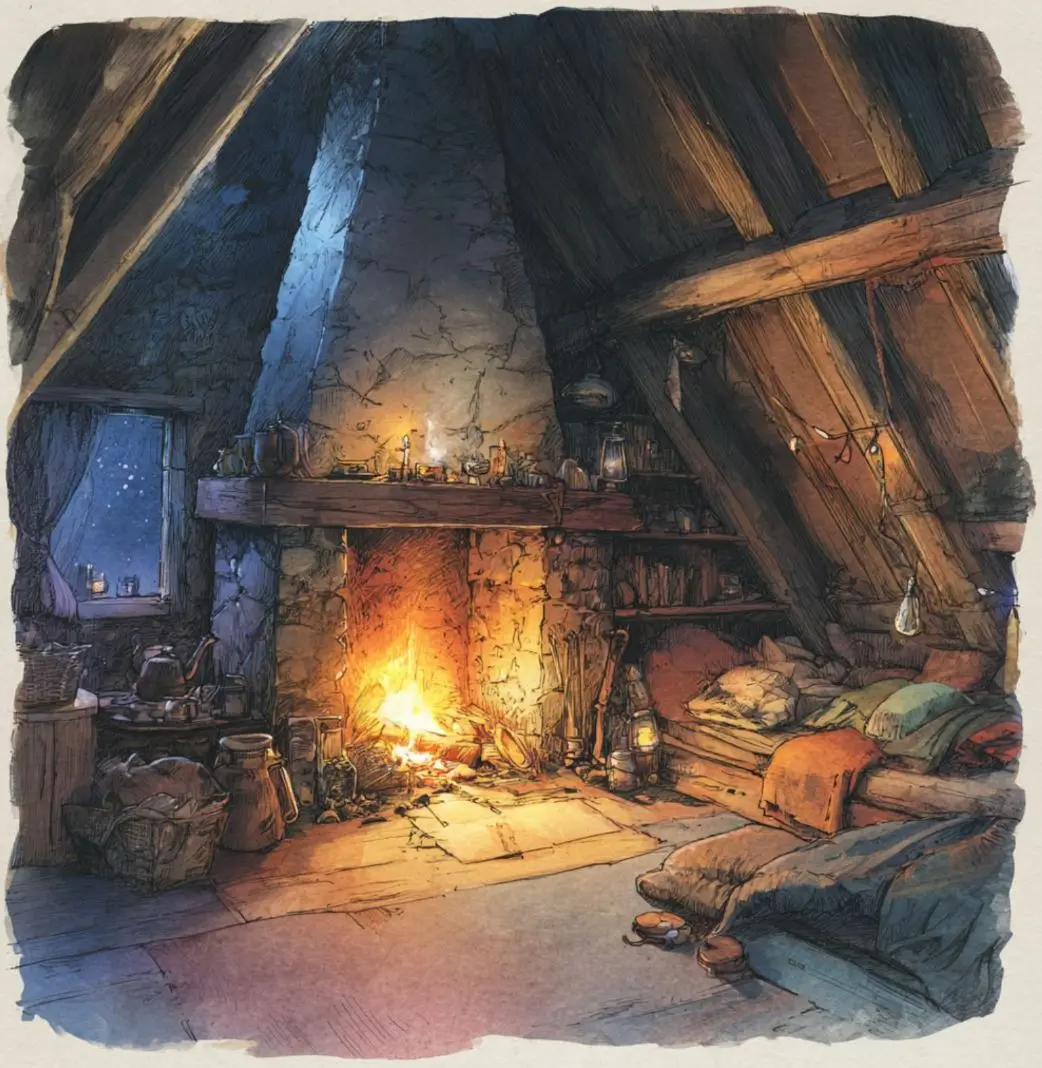
But the hearth was also a gateway to other realms. Countless stories describe malevolent spirits emerging from the oven’s mouth or vanishing down its throat. In one popular tale, a lonely traveler shelters overnight in a peasant’s hut and, as soon as the family sleeps, up to a dozen witches pour from the stove. Scrawling a magical shard on their captives’ arms, they hurl them skyward as if on an invisible conveyor – until the poor wanderer, trembling with fear, flings himself free and watches his tormentors vanish into the night.
Water-spirits and rusalkas too found their way into human homes only to slip away through fiery portals. After their seasonal sojourn among the living, mermaids return to water, earth, or –sometimes – into the glowing hearth. At Christmas, young women still whisper of hearing the name of their future husband drift down the chimney on holy night winds. And on the same vigil, the voice of a far-off traveler – beloved and long overdue – might echo through the flue, calling them by name.
Divine Flames and Forked Bolts
In Ukrainian myth, the blazing sun and crackling lightning were not mere natural phenomena but manifestations of “heavenly fire” itself. Across cultures, this celestial flame took on living form: Egypt worshipped Ra, Sumerians revered Itu, the Greeks called upon Helios, and ancient Iranians honored Khore. In the Slavic lands, too, fire deities stood at the very center of cosmic balance. Svarog, the great smith of the heavens, forged the world’s order; Dazhbog bestowed warmth and bounty; Yarilo heralded the sun’s youthful vigor in spring. Even the Egyptian Horus found a distant echo in these sky-born gods, uniting peoples by their shared awe of the life-giving sun.
With the coming of Christianity, many pagan gods were quietly reshaped into saints. In Ukraine, the warrior-saint Yurii (St. George) supplanted the old thunder-god, inheriting his power over storms, his protection of farmers and livestock, and his fierce embodiment of spring’s returning warmth. Villagers came to see Yurii’s flaming halo and spear as the very symbol of the sun’s rekindled blaze – a heavenly champion who kept frost at bay and ensured that fields would once again burst into green.
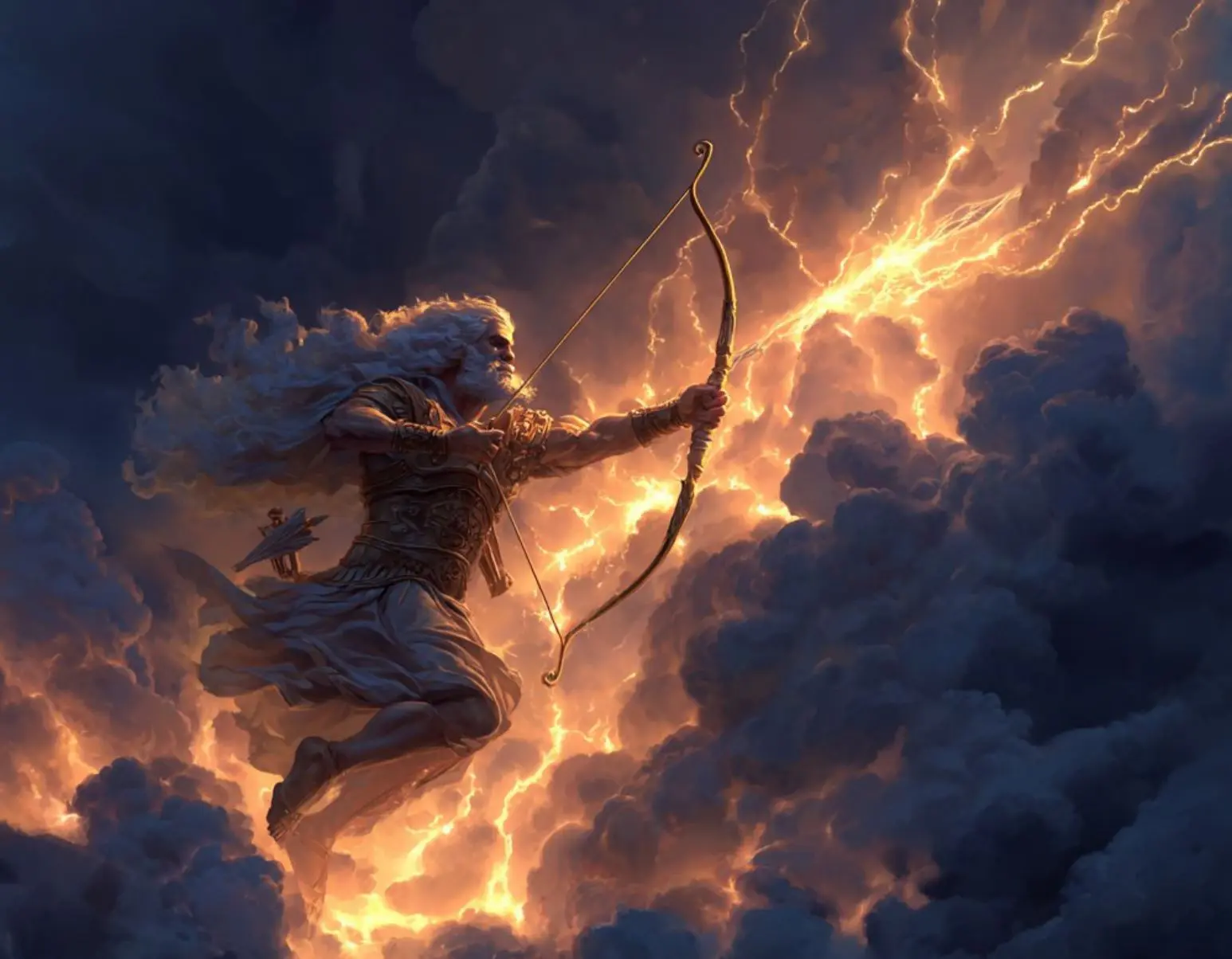
In many tales, lightning was likened to the flaming arrows of St. Michael or the fiery rod of the prophet Elijah. When wicked spirits conspired within roiling storm-clouds, it was Elijah who swept down from heaven with his blazing staff. One mighty swing would unleash a forked bolt of lightning that scattered devils like chaff – and would usher in the rolling peal of thunder that announced divine victory. Such stories reinforced the notion that heavenly fire was ordered, righteous, and always on the side of good.
From the sun’s steady burn to the sudden flare of thunderbolt, Ukrainian mythology elevates fire to the level of living force – capable of creation, destruction, and moral judgment. Whether revered in the person of a sky-god or wielded by a humble villager’s incantation, the elemental flame stands at the crossroads of human hopes and fears. It warms the hearth and defends the homestead; it punishes sin and guides the righteous. In every crackle and glow, it reminds us that fire, once unleashed, is forever entwined with the destiny of both earth and sky.